Introduction
For centuries, cannabis has been used in traditional medicine to address pain, inflammation, and a wide range of ailments. Only in recent decades, however, has modern science begun to uncover how cannabis interacts with one of the body’s most complex networks: the immune system. Emerging research suggests that cannabinoids—the biologically active compounds found in cannabis—may influence immune activity in nuanced and sometimes unexpected ways.
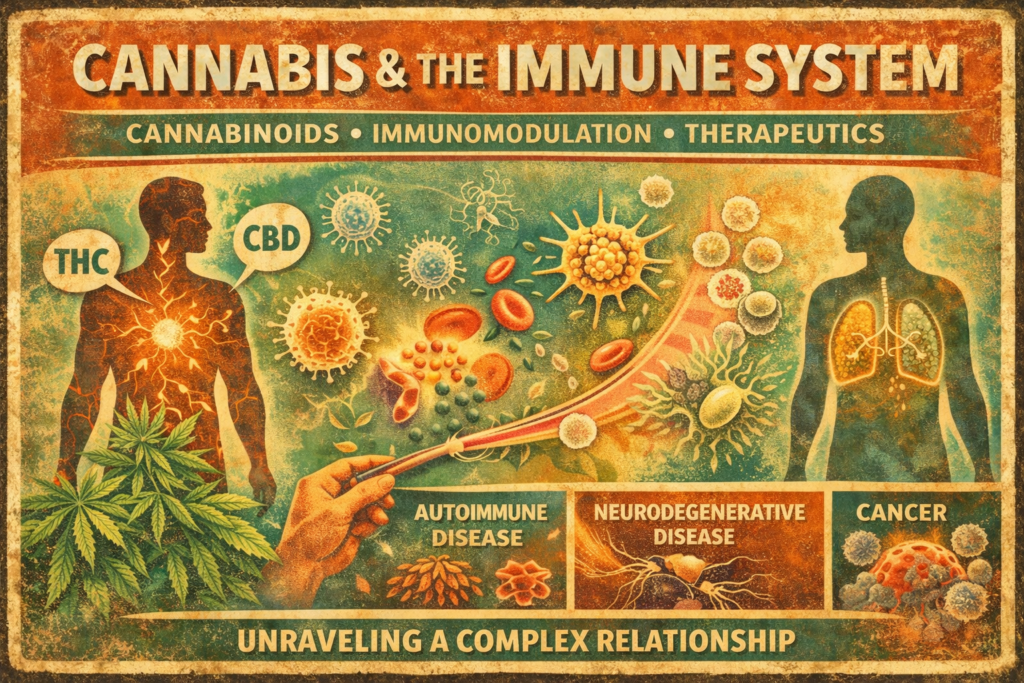
This article explores what researchers currently understand about the relationship between cannabis and immune function, with a focus on cannabinoids such as THC and CBD, their immunomodulatory effects, and the potential implications for treating inflammatory and immune-related conditions.
The Endocannabinoid System and Immune Regulation
At the center of cannabis–immune system interactions is the endocannabinoid system (ECS). The ECS is a signaling network composed of receptors, enzymes, and naturally occurring cannabinoids produced by the body. Its primary role is to help maintain physiological balance across systems including the nervous, immune, and metabolic systems.
Two key receptors define much of the ECS’s activity: CB1 and CB2. While CB1 receptors are most abundant in the brain and central nervous system, CB2 receptors are heavily expressed on immune cells such as macrophages, T cells, and B cells. This distribution strongly suggests that the ECS plays a meaningful role in immune surveillance, inflammation, and immune response coordination.
Endocannabinoids like anandamide and 2-AG naturally bind to these receptors, helping regulate processes such as cytokine release, immune cell activation, and inflammatory signaling. When external cannabinoids are introduced through cannabis, they can influence this system—sometimes amplifying and sometimes dampening immune activity.
Cannabinoids as Immune Modulators
Cannabinoids do not act as simple on-or-off switches for the immune system. Instead, they function as modulators, meaning their effects can vary depending on dosage, biological context, and the underlying immune state.
THC and Immune Suppression
THC, the primary psychoactive compound in cannabis, has been widely studied for its effects on immune signaling. Research suggests that THC may suppress certain immune responses, largely through activation of CB2 receptors on immune cells. In experimental models, THC has been shown to reduce the production of pro-inflammatory cytokines and limit immune cell migration—mechanisms that may help explain its anti-inflammatory effects.
These properties have drawn attention in conditions where immune overactivity contributes to tissue damage, though they also raise concerns about potential immune suppression in vulnerable populations.
CBD and Context-Dependent Effects
CBD presents a more complex profile. Unlike THC, CBD does not strongly bind to CB1 or CB2 receptors. Instead, it influences immune function indirectly by interacting with multiple signaling pathways, including inflammatory enzymes, cytokines, and oxidative stress responses.
Some studies suggest CBD can reduce inflammation and protect against immune-mediated damage, particularly in neurological conditions. Other research indicates that CBD may, under certain circumstances, stimulate aspects of immune signaling. This duality highlights an important theme in cannabinoid research: immune effects are highly context-dependent and cannot be generalized across all conditions.
Potential Therapeutic Applications
The ability of cannabinoids to influence immune behavior has positioned them as potential tools in treating diseases rooted in chronic inflammation or immune dysregulation.
Autoimmune and Inflammatory Disorders
Autoimmune diseases occur when the immune system mistakenly attacks healthy tissue, leading to persistent inflammation and damage. Cannabinoids have been studied for their ability to reduce immune overactivation in conditions such as multiple sclerosis, rheumatoid arthritis, and inflammatory bowel disease.
Clinical and preclinical research suggests that cannabinoid-based therapies may help alleviate symptoms such as pain, muscle spasticity, and inflammation, potentially improving quality of life for patients with autoimmune conditions.
Neurodegenerative Diseases
Chronic neuroinflammation is increasingly recognized as a contributing factor in diseases like Alzheimer’s and Parkinson’s. Cannabinoids have demonstrated anti-inflammatory and neuroprotective properties in animal models, where they appear to reduce inflammatory markers and protect neurons from progressive damage.
While these findings are promising, translating them into effective human treatments remains an active area of research.
Cancer and Immune Signaling
In oncology, cannabinoids are primarily studied for symptom management and potential anti-tumor effects. However, some research has also examined how cannabinoids influence immune activity within the tumor environment. Early findings suggest cannabinoids may alter cytokine signaling and immune cell behavior in ways that could impact tumor progression, though the clinical relevance of these effects is not yet fully understood.
Limitations, Risks, and the Need for Caution
Despite growing interest, cannabinoid-immune interactions remain incompletely understood. Much of the current evidence comes from laboratory or animal studies, and large-scale human clinical trials are still limited.
Importantly, immune modulation is a double-edged sword. While dampening inflammation may be beneficial in autoimmune disease, suppressing immune function could be harmful for individuals with compromised immunity or those fighting infections. This complexity underscores the importance of individualized assessment and medical supervision when considering cannabinoid-based therapies.
Regulatory uncertainty and variability in product quality further complicate clinical use, reinforcing the need for standardized formulations and clear dosing guidelines.
Conclusion
The relationship between cannabis and the immune system is intricate, multifaceted, and still unfolding. Cannabinoids such as THC and CBD have demonstrated the ability to influence immune responses in ways that may hold therapeutic value for inflammatory, autoimmune, neurodegenerative, and oncologic conditions.
At the same time, these effects are highly context-specific, and broad assumptions about immune benefits—or risks—are not supported by current evidence. Continued research, particularly well-designed human trials, will be essential to determine where cannabinoids can be safely and effectively integrated into immune-related treatment strategies.
As scientific understanding deepens, cannabinoids may emerge as a new class of immunomodulatory tools—but only if guided by rigorous research, thoughtful regulation, and evidence-based clinical practice.